Showing posts with label Payment. Show all posts

Global Energy Recruitment And Payroll Solutions In Netherlands

global energy recruitment payroll solutions netherlands

The energy sector is rapidly evolving, requiring specialized expertise and agile recruitment solutions, particularly in the Netherlands. With a growing focus on sustainable energy, the demand for skilled professionals in this sector is higher than ever. 

As companies navigate the challenges of talent acquisition and management in the global energy market, specialized recruitment and payroll services become essential. In the Netherlands, organizations like WTS Energy are leading the way in delivering these solutions.

Understanding Recruitment Needs In Energy 

Recruitment in the energy sector involves identifying and attracting the right talent for specialized roles. These may include positions in renewable energy, oil and gas, and new technology development. 

The Netherlands, with its robust energy infrastructure and commitment to innovation, presents unique opportunities and challenges in this regard. Companies need to find candidates who not only possess technical expertise but also align with sustainability goals. 

To address these needs, recruitment agencies offer tailored services, connecting employers with candidates who have the necessary skills and values. This alignment is crucial for fostering innovation and driving industry growth. 

Navigating Payroll Solutions 

Managing payroll for a diverse, often global workforce is another critical aspect of energy sector operations. In the Netherlands, ensuring compliance with local regulations while managing international payroll demands meticulous attention to detail. 

Payroll services not only handle salary disbursements but also address tax requirements, employee benefits, and compliance obligations. This ensures smooth operations and minimizes legal risks for companies operating in multiple regions. 

With advanced technology, payroll solutions can now integrate data from various sources, providing real-time insights and promoting financial efficiency. The synergy between recruitment and payroll is vital for maintaining an agile workforce. 

This integration supports organizations in focusing on core business activities, while expert payroll management ensures all administrative processes are handled efficiently. 

Employer Of Record Services 

Employer of records in the Netherlands services offer a strategic advantage for companies looking to expand into new markets, including the Netherlands. By acting as the legal employer, EOR handles HR responsibilities, allowing companies to focus on strategic growth. 

These services are particularly beneficial for energy companies aiming to scale operations quickly without establishing a physical presence. By leveraging EOR solutions, businesses can navigate complex employment laws and reduce risk. 

Staying Competitive In The Global Market 

In the competitive global energy market, having an adaptable and competent workforce is essential. Recruitment and payroll solutions play a crucial role in achieving this by ensuring companies can attract and retain top talent. 

Working with specialized agencies like WTS Energy enables energy firms to streamline operations and remain competitive. These agencies offer insights and expertise that are vital for effectively navigating the complexities of the international energy sector. 

By adopting a holistic approach to workforce management, companies can align their human resources strategies with broader business objectives, ensuring long-term success. 

Challenges And Opportunities 

The dynamic nature of the energy sector presents both challenges and opportunities for recruitment and payroll solutions. As technological advancements drive industry changes, companies must be agile and innovative in their approach. 

Understanding market trends and adapting to the rapidly changing landscape is key to thriving in this environment. Embracing digital tools and a flexible workforce strategy enhances operational resilience. 

By transforming these challenges into opportunities, companies can not only survive but thrive in the global energy market. 

Conclusion 

Global energy recruitment and payroll solutions in the Netherlands are crucial for supporting the industry's growth and innovation. By effectively managing talent and payroll, companies can maintain a competitive edge. 

As the energy landscape continues to evolve, companies must leverage specialized services to navigate complexities and seize new opportunities. Staying informed and agile is imperative for future success.

Empower Your Online Business With Fondy: The Future Of Automated Payouts

online business fondy automated payouts

As the digital marketplace becomes increasingly competitive, ensuring efficient and transparent payouts to partners is a priority for every two-sided platform. British entrepreneurs and marketplace owners can now harness the power of Fondy Flow — a state‑of‑the‑art fintech solution that simplifies the way you handle partner payments. 

Breaking Down Barriers With Global Payouts 

In today’s borderless economy, the ability to process international payouts is a critical advantage. Fondy Flow’s robust system supports multiple currencies and payment methods, empowering your platform to connect effortlessly with partners worldwide. This not only enhances trust but also ensures your business is ready to tackle the challenges of a global market. 

The Efficiency Of Automation 

Time is money, especially in high‐volume environments. Fondy Flow leverages automated payout technology to streamline the entire payout process. By automating routine tasks, the system reduces errors and frees up your team to focus on strategic growth initiatives. This means quicker, more reliable payments that keep your business running smoothly. 

Customised Payment Schedules For Every Business Model 

Understanding that every business has unique needs, Fondy Flow offers the flexibility of a delayed payout option. Whether you require a pause for service verification or need to manage complex commission structures, delayed payouts give you the control to align the payment process with your operational goals. 

Clarity In Cost Management 

An essential feature for any financial system is transparent fee management. Fondy Flow clearly outlines every payout fee (more here), ensuring you know exactly where your money is going. This transparency in pricing helps you maintain better control over your expenses, allowing for more predictable budgeting and financial planning. 

Easy Integration, Robust Support 

Getting started with Fondy Flow is both fast and straightforward. The platform’s user-friendly interface, combined with comprehensive API documentation, makes integration a breeze. With real-time analytics and detailed transaction reporting, you can monitor every aspect of your payout operations, ensuring that your financial processes are as efficient as possible. 

For British business owners seeking a scalable, secure, and transparent payout solution, Fondy provides an unparalleled advantage. Discover the power of streamlined partner payouts and see how Fondy’s innovative approach can elevate your online business to new heights.

Why Do Businesses Need Transaction Reporting Tools?

businesses need transaction reporting tools crm software

An effective help desk ticketing system is beneficial to any business, regardless of its size. Such a tool is beneficial for organizations that want to keep track of issues and to address the concerns of their customers in a timely manner. Nowadays help desk tickets are used widely to streamline the workload within an organization and to deal with internal or external support requests. Another valuable feature used by numerous companies these days is transaction reporting, which is meant to keep track of transactions, to manage them and to issue reports. 

How Can Help Desk Tickets Benefit Organizations? 

It is important to understand how a ticketing system works, what advantages it brings and what to look for when shopping for such software. According to an interesting article on Bootstrap Business, "A help desk ticketing system is a software-based hub for your employees to help organize problems into a more manageable workflow. " Employees deal with all sorts of information and help desk tickets will be assigned to them and it will contain useful information such as who made the request, what was done so far to solve the problem and so on. 

It is possible to assign a level of importance to each desk ticket request, thus being able to prioritize issues that are more pressing. There are also tools that automate this process entirely and that streamline the customer support process to a great extent. Organizations that find it difficult to organize customer tickets and to deliver a response in a timely manner will find help desk tickets very useful and they will not hesitate to implement them to deliver a positive customer experience. When using ticketing software, an issue is created automatically when an issue appears. It is also possible to sort tickets automatically and to have them prioritized and sent to the right agent. 

A ticketing system brings a wide range of advantages that should not be overlooked such as: 

• Streamlined operations- by automating most of the ticketing process, those responsible for ticket support can resolve existing issues much faster and this results in increased efficiency. 

• Reduced resolution times and ticket backlog- problem resolution should be a priority to all businesses and this is no longer an issue when this process is automated; employees have access to relevant information when receiving a ticket and this enables them to assess the situation and see what needs to be done. 

• Establish a personal connection- clients appreciate companies that do their best to resolve their problems as soon as possible and they want to see that they are heard. 

• Improved ticket organization- when using a ticketing system nothing is left out and each ticket can be organized by a specific criterion. 

When To Use Transaction Reporting 

When implementing new software to streamline operations within organizations, it is imperative to know what to look for and what features can make a difference. Businesses with numerous transactions should find a way to manage them easier and to access the information they need with just a few clicks of the mouse. Thanks to transaction reporting it is possible to view merchants deposits, daily batches, account status, retrievals and chargebacks and so on. This feature is designed to simplify various processes within an organization and using it will make a difference. 

Reporting features have become a necessity for most businesses and it makes sense to use these tools to increase customer retention. According to an interesting article in Discover CRM, "Reporting allows businesses to zero in on customer behavior, improve the experience and increase retention. It’s not just retention; CRM reporting helps businesses identify and sell with precision, but you have to get it right." Thanks to transaction reporting, it is easier for organizations to see exactly what happens in their business. Furthermore, managers can use the available data to make the best decisions, to track performance and to make changes when it is the case. 

Reporting features can be used by the sales team, by the marketing team and to analyze customer data. Customers are at the core of any successful business and it is important to understand them in order to cater to their specific needs and keep them happy. CRM features such as reporting make it possible to build customized customer reports, profitability reports, sales metrics reports, goal progress reports and so on. 

What To Look For In Help Desk Tickets 

There are all sorts of ticketing systems out there, some better than others. It is important for organizations to decide on what matters the most to them, what features to look for so that they find a tool that aligns with their specific requirements. Businesses that are in the market for a new tool should pay attention to the following features: intuitive and user-friendly interface; employees should be able to access the ticketing system without any hassle, otherwise using such a tool is pointless. Other useful features are email to ticket conversion, which converts messages into tickets, automatic ticket assignment and live chat and social media integration. 

It is recommended to choose help desk tickets tools wisely to make the most of them. Moving on to transaction reporting, this a feature that should not be ignored for it can streamline operations for all sorts of businesses, regardless of their size. Reporting features can impact all aspects of a business, starting with sales and ending with employee productivity and their importance should not be overlooked. 

CRM tools should be used to understand customers and their practices so that organizations can connect with them on a deeper level. These tools are meant to improve customer relationships and to boost productivity within an organization. It is worth mentioning that they come with all sorts of features but it is entirely up to each organization to decide what matters the most to it, whether it needs help desk ticketing, transaction reporting and so on. Higher customer satisfaction should be a priority for all businesses for happy customers are more likely to return to them whenever they need what they have to offer.

How To Get A Salary Advance Loan Approval

how to get salary advance loan approval fast cash

What Is A Salary Advance Loan? 

Salary advance loans are temporary solutions for salaried individuals seeking out credits for the short term due to immediate financial need. But the interest rates for this particular loan type is usually high and is calculated either on a monthly or daily basis, depending on the lenders. You have to be careful which lender you choose to avoid exorbitant interest rates that can get out of control fast.  

GET US AND CANADA LOANS APPROVED FAST HERE

People with even average credit scores can also apply for the same. However, because of their high-risk nature and fast processing time, these loans have high APR, and the repayment terms are also in favor of the lenders. 


Top Applications For Salary Advance Loans

Many applications or companies are providing Salary Advance Loans. 

● Early Salary 
● Loan Tap 
● Quick Credit 
● Cash Kumar 
● Credit Bazaar 
● Flex Salary 
● Payme India 

All of these applications provide different interest rates for loans on salaries. 

A Salary Advance Loan Calculator is also used to calculate the estimated interest amount based on loan tenure and loan amount. Borrowers also can use the calculator to calculate their personal, house and other loans. 

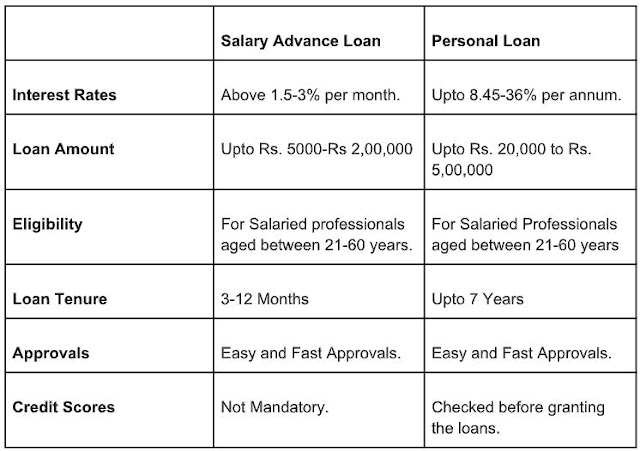
Differences Between Salary Advance Loans And Personal Loans 

Salary is remuneration provided to employees every month for performing their roles in the company. When employees apply for a loan against a salary account, they literally promise the lender to pay off their debt on the next credit of their salary. Advance payment of salary is when the company obligates their employees by crediting the salary in advance so that the borrower can meet the current contingencies. Personal loan is again the loan provided to salaried people, against a mortgage other than salary account.  

how to get salary advance loan approval

Eligibility For Availability Of Advance Salary Loans 

Lenders do not go into the details for past credit histories while providing Advance Salary Loans. But the borrower needs to meet some conditions to be eligible for the loan type. 

● · Borrower’s Age must be or above 21 years. 

● · The net salary or profits from the business must at least draw: 

- Rs.40,000 for Mumbai, Hyderabad, Chennai, Thane or Delhi residents. 
- Rs.35,000 for Pune, Kolkata and Ahmedabad residents. 
- Rs.30,000 for any other city resident. 

● · The borrower must have an active and operating Savings Bank Account. 

● · They need to be residents of India. 

● · They need to have all the documents in hand. 

Documents Required For Salary Loans And Advances 

● Photogenic Identity Proof: Driver’s license, voter ID, Passport or Pan Card. 

● Address Proof: Internet or Telephone Bill, Driver’s License, Certified Employer Letter, Ration Card, House Deed, Passport. 

● Signature Proof: Bank Verification Letter, Pan Card, along with some signatures. 

● Age Proof: PAN Card, Driver’s License, Birth Certificate, Passport. 

● Passport Sized Photograph: Keep Around 4-5 in hand with you while applying. 

● Current and Previous Employment: Confirmations, Transfer or Appointment Letters. 

● Financial Statement: Pay Slips. ITS Report or audited financial reports for salaried person 

● Employment Proof: Business Visiting Card or Employee ID. 

● Bank Statements: Salary Credited Bank Statement for last three months. 

How To Get An Advance Salary Loan Approved 

The borrower needs to follow some simple steps to apply for advance salary loans. These steps include: 

· Filling out the application form. The form needs to be filled out with some required personal information and income details. 

· Wait for the approvals after filling out and submitting the forms. 

· Collect the essentials and required documents for the KYC process. 

· After the verification of documents, the amount is credited to the borrower’s account. 

Benefits And Features Of Salary Advance Loans 

Zero Or Minimal Closure Charges: Borrowers have an open option to close their loans by paying the amount earlier. This will not levy any penalties or additional charges on them. 

Part Prepayment facilities: Borrower can pay out their loan amount either in EMI’s or full amount at once, depending on the lender. 

Online Account Access: Lenders offer the facility to keep a real-time check on the finances they owe and the total amount they need to pay in total at the end. 

Financial Emergencies: You can sort out the financial emergency issues with advance salary loan options, as they have a flexible time repayment period. 

Insurance Cover: Some lenders will also provide credit shield facilities and personal accident cover additionally with the loans. 

Tips For When To Borrow Money On A Salary Advance Loan 

Salary Advance Loans have comparatively higher interest rates. These are thus ideal only for wants or some financial emergencies. Going for the loan type to cover leisure expenses is strictly not advised. 

There are certain financial crunches where employees can apply for the same. These include: 

● Unexpected Financial Setback 
● Bereavement Costs 
● Family Emergencies 
● Health Emergency 
● Payment of bills not covered under insurance 

These are typically not an ideal option for daily or regular payments. Making this a habit will put the borrower in more debt, as he might be ending up paying triple the amount he has borrowed every time. 

Frequently Asked Questions (FAQs) About Advanced Salary Loans

● Is an advance loan on salary taxable or not? 

The amount received under the advance salary loan is taxed in the yearly receipts of the employees. 

● What is the advance salary loan interest rate? 

The interest rate for this particular loan type varies between 1.5% to 3%. 

● Is an advance salary loan accepted without a credit report? 

Credit Scores and reports are not mandatory while applying for salary advance loans. 

● Can I use an application to deposit a cheque against an advance salary loan? 

The borrower is provided with flexible repayment options. They can pay back the amount with applications or websites also. 

Keep these tips in mind if you are seeking a salary advance loan approval fast!

The Top PayPal Casinos In South Africa

paypal casino benefits deposits withdrawals

What are the advantages of using PayPal for South Africa? 

Many players know that a good game, you need reliable methods of payment. 

A top Paypal casino south Africa today is the most reliable and fastest tool for payments. 

The advantages of using PayPal for your online casino deposits are many. 

Advantages Of Using PayPal For Online Casino Deposits 

• It Is Safe 

It is true that you must enter your account or card details, but once you have done so, you will not have to do it again and they will be encrypted under a complex security system. 

• It Is Free 

Signing up is completely free, and you will not have to pay any kind of monthly or annual fee. 

• It Is Flexible 

You can associate several debit or credit cards so your payments will always be accepted. You don't need to have a balance in your PayPal account because when you make a purchase it will be deducted directly from the card you have registered. 

• You Can Withdraw Money 

You can send and receive money and, in the case of online casinos, you can withdraw your winnings to your own PayPal account and then use that money or send it to your bank account. 

• Instant Currency Exchange 

It has commission, but you will be able to make an instant currency exchange. 

• Dispute Resolution 

If you have any kind of problem with the product purchased or the amount paid at any merchant, open a dispute and PayPal will verify that everything went correctly. 

What Are The Disadvantages Of Using PayPal? 

• Disputes 

It also has its negative side, and it is that certain people of dubious morals use this to paralyze payments in transactions and take advantage of the buyer protection offered by PayPal. 

• Commissions 

In certain countries and depending on the transaction you make, there may be fees to pay, although normally they will always be lower than those of a bank. 

• Counterfeiting 

Be careful with places that pretend to be PayPal. Make sure you are always on the official PayPal website. 

How To Open A PayPal Account? 

If you don't have a PayPal account yet, opening one is very easy. You just need to go to their website and follow a few simple steps. 

- First click on the "Create a free account" button in the central part of the screen. Then you must choose whether your account will be personal or business, the latter being focused on business use. 

- Then fill in the form with your personal data (country, name, email and password), and by simply accepting the terms and conditions and activating your account through the email you will be sent, you will be ready to start using PayPal. 

- The next step is to add a credit card to your PayPal account. 

How To Add A Card To Your PayPal Account 

To add a debit or credit card to your PayPal account follow these simple steps: 

First log in to your account by clicking on the top right button, and filling in your username and password. In the top bar, click on the "My wallet" button. 

You will have several options in front of you, being on the left the ones to link a card or a bank account to your PayPal account. Click on the option you need in your case and just fill in the data and everything will be linked. 

How To Deposit And Withdraw Money With PayPal In Online Casinos? 

Depositing money with PayPal at online casinos is very easy. 

Once you have registered at the casino, and logged in, you will have to find the deposit page and choose PayPal. 

Then select the amount you want to deposit and the next page will ask you to log in to your PayPal account. 

You will then be able to make the payment using the balance you have (if any) in your account or choose the card or bank account you have associated to use their funds. Once you make the payment the casino will confirm it to you. 

To withdraw money is even simpler. What you have to do is go to the casino's withdrawal page and select PayPal. 

Enter your PayPal ID (your email address or username) and request the amount you want to withdraw to your account. 

Within 2 to 3 business days you will receive the money in your bank account from this top online casino platform.

3 Recent Business Trends To Consider Adopting

top recent business trends consider adopting for your company new startup strategies

Keeping your business relevant is very important for an owner in any economy. Doing so may ensure that your company can compete, especially in a highly popular market. However, staying relevant can be difficult in our current global marketplace. You may not know what changes to make in the new normal. 

So, here are three top business trends to consider adopting for your own established company or new lean startup. 

1. Remote Work 

Remote work has been steadily growing in popularity, even before the pandemic started. This is mainly due to how convenient it is. For business owners, having remote workers can result in lower utility costs. You could even get rid of your building altogether. It may also allow you to work with people who are far away, which could provide a wider net of talent. 

For employees, working at home can create more time to get other things done. It can also cut down on travel expenses. If you're worried about teamwork and collaboration, don't be. Methods like video conferencing can allow for easy communication amongst coworkers. 

2. E-commerce 

E-commerce is a trend that seems to be taking over the world of shopping. While consumers still visit stores, particularly to try clothes on, shopping online has become wildly popular. For one thing, e-commerce allows shoppers to save time, money, and energy, especially if you offer delivery. Also, e-commerce can help you reach customers from all over the world. 

If you'd like to adopt this ecommerce trend, start by sprucing up your website. Make sure it completely represents your brand. Afterward, simply add a shopping page to your site and set up a payment option. It's also highly important to constantly check your messages. If a customer has an issue on your website, you should be able to fix it immediately. A top e-commerce website is a relatively low-cost way to improve your business.

3. Various Payment Options 

In this day and age, taking cash or a card for payment may not be sufficient. Customers, especially younger ones, want to have easier options available. One thing to try is accepting online payment from services like Venmo, PayPal, Square, Samsung Pay and Apple Pay. This allows customers to limit interaction and pay through a phone. You could also accept contactless payment, which can make the process both quicker and easier. A growing number of customers now also want to pay with popular cryptocurrencies like Bitcoin, Ethereum, and Dogecoin crypto.

Whatever you decide to accept, be sure to advertise it clearly before and near your checkout and your point of sale (POS) system if you run a brick and mortar business. Otherwise, you may have a long line of people wondering how to pay or realizing at the register area that they aren't ready with the required payment method. You might even lose some customers completely if you don't accept the payment options that they prefer or have sluggish systems.

Top Trends For Big Businesses

Following business trends is an essential task for business owners. While you don't need to adopt each one, especially if a certain trend is expensive, it's important to know what you're competing against. Stay relevant and keep the future in mind.

Who Pays For Workers' Compensation?

who pays for workers' compensation payment

Workplace injuries are far more common than you might think. No matter what industry you work in, you will be exposed to injuries in one form or another. However, that doesn't mean that dealing with a work-related injury is easy; it's not. Fortunately, you can apply for a workers' compensation settlement. These benefits will help you get through this challenging time in your life. But you may be wondering, who is paying for them? 

Workers' compensation systems often vary from state to state. However, employers usually pay for workers' compensation benefits in one of three ways: through state-run insurance programs, private insurance companies, or via direct payments to their employees. 

After a workplace accident, the company providing your workers' compensation benefits may or may not be your employer. Regardless, the benefits will be the same in either case. However, you must know which organizations may be in charge of processing your claim. 

State-Run Insurance Programs 

In many states, employers may choose to procure workers' compensation insurance through state-administered programs or a state insurance fund. These types of programs are usually administered by an individual state's department of commerce or labor department. Generally, state programs such as these are chosen by employers with few employees or industries where work-related accidents are infrequent. 

State programs are usually created to compete with private insurance companies and keep costs down. That way, companies with less frequently occurring injuries can opt for a less expensive state program that provides the coverage they need. 

If a state-run program covers your employer, the agency responsible for the program will be responsible for paying for your workers' compensation benefits. In essence, the state department will act as an insurance company would. 

Insurance Companies 

Your employer may also choose to pay a premium to an insurance company to obtain workers' compensation coverage. Private insurers' policies are often more expensive than state programs, but they also offer broader and more comprehensive coverage. Furthermore, when an employer chooses to pay an insurance company, they often prevent their employees from suing them directly after an on-the-job injury

If the company you work for has a private insurer, they will be responsible for accepting and processing your claim. However, this is often not as easy as it sounds. 

After a work injury, filing a claim with an insurance company can be complicated. Rest assured that some insurers will go out of their way to avoid honoring their policies and save money in the process. That means your claim could be delayed indefinitely or even denied altogether. 

In these cases, working with a Los Angeles workers' compensation attorney, such as C&B Law Group, may be your best alternative. The attorney will stand up to the insurance company on your behalf and increase your chances of receiving the compensation you deserve. 

Self-Insurance 

In many states, employers have the option to "self-insure." However, they will have to demonstrate that they have sufficient assets and equity to provide adequate coverage for their employees. Also, states often require these companies to verify that all employees can receive the benefits owed to them. 

These large companies often use "third-party administrators" to deal with claims. This administrator handles all the paperwork and the management of each claim. Further, they will pay the injured worker directly on behalf of the company. 

If your employer is self-insured and you suffered a work-related injury, talking to a workers' compensation attorney near you may be an excellent idea. Your employer may dispute your eligibility since they have a lot of money at risk. However, your attorney will take care of defending your rights at all times while you focus on your recovery. 

If you have further questions about the workers' compensation process, consider speaking with a California workers' compensation firm, such as C&B Law Group. These experienced attorneys offer free consultations, so don't hesitate to call them if you want to know your case's value in minutes.

Merchant Account Fees Guide

merchant account fees guide payment charges

It's always good to know why you are paying the fees that you are for service. It opens avenues for you to understand whether or not a merchant fee is even justified. Opening a new merchant account or trying to maximize profits by minimizing expenditure require proper know-how of the fees you are being subjected to and how to save oneself from any unnecessary fees that the merchant account providers are notorious for charging their clients. 

In a nutshell, a transaction is initiated the minute the credit card credentials enter the sales terminal of a store or a business. This can be either a "card not present" or a "card present" transaction based on your business. Based on the cash that the customer pays, the account provider will charge you a certain fee. This depends on several factors, such as the bank of the customer, the bank where the merchant's account is present, and the card's issuing bank. Each provider has different ways of charging their clients. 

Below we will discuss all the various fees that a merchant can be subjected to by their provider. There are three main types of fees involved in a merchant account. They are transactional, flat, and incidental fees. Some if not all, of these fees are negotiable and can be waived off. 

Top Types Of Merchant Account Fees

Wholesale And Markup Fees 

For this, we will have to dive a little deeper into the basics of retail operations. When a merchant or shopkeeper buys their stock, they buy them at a "wholesale rate."This is when the producer gives them when they buy stuff in bulk that they have to retail later. The merchant then adds a markup. This markup caters to all the costs that are associated with the process of retail. When someone operates a retail store, they not only have to make profits out of the stock they buy, they have to make up for their operating costs and any other costs that come with selling the stock. 

Interchange Fees 

The wholesale fees typically translate to the network and Interchange fees that come with card- based transactions in terms of merchant service providers. The credit card association charges the network fees to the merchant's bank or any third party service hired by them. After that, the issuing authority of the card charges interchange fees consisting of a fixed amount and a percentage of the sale for which the transaction is being done. 

Markup Fees 

This is a similar concept to standard retail. The Markup fees are charged by the Merchant service providers on top of the interchange fees or network fees that are due to the card association and issuing bank, respectively. The markup fees are what your merchant service provider would charge for processing your transaction between the issuing bank and your bank. These fees vary across various merchant service providers. Some providers choose to disclose it while others do not. 

Transactional Fees 

These make up for the most significant portion of the merchant fees. These are based on two different things, the interchange fees or, as some card associations call it, discount rate. And secondly, a transaction fee, this part applies to any of the fees that occur during the transaction. There are wholesale and markup fees with each transaction, and there are a total of 5 types of transaction fees. They are; 

• Fees Of Interchange And Assessment: These are non-negotiable fees by the issuing bank and card association. 

• Fees of Authorization: the fee to run the transaction can be charged by the payment processor, naming it as authorization fees. 

• Fee Per Item: Other than the authorization fees, per item fees can be charged by the processor each time the merchant makes a transaction through the credit card terminal. 

• Communication Fee: Each time the credit card terminal sends or receives information from the processor or the bank, the processor may charge a fee. 

• Wireless Service's Fee: if you use a wireless network to process your transaction, you will be paying an additional wireless fee to avail of that service. 

Flat Fees 

Flat fees are fixed fees that you will be paying your payment processor. Usually, a provider charges multiple types of flat fees to the merchant, and these can be recurring, one time or annual. The types of flat fees that you can be paid are; 

• Address Verification Fees: For CNP transactions, the AVS fee applies to confirm the cardholder's address to verify the transaction. 

• Annual Service Fee: Some providers take a yearly fee for their service. 

• Batch Fee: This is the end of day transaction processing fees, and it can be per item or just a flat fee. 

• Gateway Fee: this can be charged alongside the AVS fee. And can be waived off in the case of an in-house gateway system for payments. 

• Fraud Protection And PCI Compliance Fees: This fee is payable regardless of whether you are in compliance or are not in compliance with PCI guidelines. The reason for that is to ensure that PCI compliance is maintained. 

• Fees Of Setting Up: This isn't charged by all providers and can be different based on your choice of a payment provider. 

• Statement Fee: the production and sending of the statement of the transactions performed are the statement fees. Electronic invoices can result in the waiver of such fees. 

• Terminal Fees: a merchant has two choices for a POS terminal. To sell or lease it. A merchant service provider would prefer that you rent it as it would result in their profit, and you would have to pay terminal fees. 

Incidental Fees 

Incidental fees are ones that occur on the instance of something. For example, there is a chargeback, or there is a returned item. The merchant would be liable for incidental fees by the payment processor. Types of incidental fees are; 

• Chargeback Fees: if a cardholder disputes a charge on their card and wins, there is a chargeback fee. 

• Fees on Returned Items: If a customer chooses to return an item that had been bought using a card, the processor can charge you fees to process the item's return. 

• Minimum Monthly Fees: each merchant service provider has their predetermined limit of earning from your business. If you fail to meet the hat limit, they will charge you to pay for the difference. 

Minimize Merchant Fees 

As you can see, there are many merchant fees out there. Keep this guide in mind as you navigate merchant fees and work to reduce costs during payment transactions or charges.

7 Ways To Avoid Extra Financial Fees

how to avoid extra financial fees bank penalties credit card interest

Living paycheck to paycheck, or month to month, is stressful and financially damaging. As soon as your paycheck comes in, you have to spend it all on necessities like rent, utilities, insurance, and paying off debt. There’s usually little, if anything, left in the check for savings or recreational activities. Then, something even worse happens: you’re hit with a fee. You might have missed a payment deadline, overdrawn your account, lost your credit card, or encountered a different situation that decided your wallet needed another gut-punch. It might only sound like $10, the cost of a frugal meal out, but it’s still $10 you don’t have and desperately need for something else. You might feel dread toward these impending fees when you pay a bill, or they come at you from out of nowhere. If you live paycheck to paycheck and want to make sure as much of your hard-earned money goes where it should, follow these seven tips for avoiding unnecessary fees. 

1. Avoid Banks That Charge Maintenance Fees 

Bank “maintenance fees” are particularly sinister. Financial institutions charge them if you don’t meet specific requirements, such as holding a minimum balance in your account ($1,500 in the case of many big banks) or making frequent direct deposits over a specified amount. You might not even be aware of them unless you check your billing statement. It’s not fair that banks charge you money for not having enough money. Maintenance fees are often monthly and can accumulate over time — Americans paid $3.5 billion in maintenance fees just a few years ago, and they've gone up since. 

These fees perpetuate the poverty cycle because if you live paycheck to paycheck or have irregular income (like freelancers), of course you don’t have $1,500 in your account at all times. Don’t use banks that charge maintenance fees. Many big banks do, but examples of financial institutions that don’t include Ally Bank, Capital One Bank 360, and FNBO Direct. 

2. Deposit Money The Slower Free Way 

Deposit money into your account the long way, if possible. This process means being patient when getting paid, especially if you’re a contractor or freelancer that relies on services like PayPal. PayPal offers multiple bank transfer options, including Standard Transfer and Instant Transfer. The former is free and takes one to three business days, but the latter costs 1% of the transaction up to $10. Opt for the Instant Transfer option when you can, or use mobile deposit with a physical check. 

3. Use Apps that Don’t Charge Minimum Fees 

However, the pay cycle is notorious for delays that make living paycheck to paycheck even more difficult. It’s entirely possible that you need your money now, not later — but what can you do about it? You can’t exactly force direct deposit to go faster. One solution is to use financial apps that allow you to access your paycheck without having to wait weeks for it. With some mobile apps you can use to access up to $100 of your paycheck per day, up to $500 per pay period. The app deducts the amount you took out on payday without mandatory fees or interest.

4. Set Up Auto Pay 

Are late fees the bane of your existence because you regularly forget to pay a bill on time? Auto pay mobile applications can help you avoid late fees, but consider setting up auto-pay on your credit card and other if you can afford to do so. This way, you never have to remember payment deadlines; your account will pay what you owe automatically. 

5. Sign Up for Low-Balance Alerts 

If you cannot risk auto-pay because you’re worried about insufficient funds, then sign up for low-balance alerts with an app or through your bank. Low-balance alerts will notify you by text message or automated email when your account balance has dipped below a certain number — possibly of your choosing, depending on the service — so that you know when it’s time to replenish your account with additional funds or to watch your budget before bills are due. These alerts aren’t perfect because banks can be slow to share information with external apps. However, they can help avoid bank overdraft fees, which financial institutions charge if you opt-in to its overdraft protection service. While the ability to overdraw your checking account and complete transactions regardless of funds seems convenient, there are other pros and cons to consider (you can also open a checking account with no overdraft fees). 

6. Use Only Your Bank’s ATM Machines 

ATM fees are one of the most-hated fees in the U.S. You incur these fees if you want to access your money from a machine that’s not in your bank or credit union’s network. Only use bank ATM machines within your financial institution’s network when possible. If none are around, you can obtain cash at a supermarket that offers cash back options with a small purchase (which sounds like a fee in itself, so only buy something you need!). 

7. Opt-Out Of Paper Statements 

Your bank is going to communicate with you, and you would be wise to pay attention. Unfortunately, many banks default to mailing paper communications instead of using digital means — and then potentially charge you for it. Log into your online account or call your bank’s customer service line to opt-out of paper notifications and save yourself some cash. 

Get The Most Out Of Your Paychecks

Unnecessary fees make it extra challenging for people living paycheck to paycheck to save money. If you want to lose as little of your money as possible to predatory financial institutions, research what fees your bank (or prospective bank) charges and which they are most likely to make you pay, depending on your financial situation.

How To Pay Social Media Influencers

how to pay social media influencers marketing campaigns payment methods

With top social media influencers bringing in 1 million dollars for a single paid Instagram post, you might think promoting through a social media influencer is out of your reach. The good news is that there are many micro-influencers that will fit into almost any budget.

What will social media influencers take as payment? How do you pay influencer marketers for their work? 

Continue reading this article to find out how to use social media influencers to boost your online marketing campaigns.


Launching A Social Media Influencer Campaign

Before you start trying to secure influencers to market your product or service, you need to make sure you have a plan in place. Figure out what your budget is and how much of a return you expect to get out of your marketing efforts.

Once you know your goals and how much you are willing to pay for social media influencers, it is time to get started.


Finding Influencers That Accept Product As Payment

You may find some influencers that will accept product as payment. These influencers are more than happy to receive clothing, supplements and other products they can use and promote. 

Many of these influencers will only accept the product as a partial payment. If you aren’t happy with a proposal, feel free to negotiate and see if they will budge.

Finding Influencers Within Your Business Budget

There are some websites that will help you find influencers, guest post opportunities, and other digital marketing tools. Many of these websites will allow you to list your request and your budget. While influencers are able to counter, in most cases you can find someone to work with you on your terms.

Do I Have To Give Influencers A 1099 Tax Form?

You do not have to give influencers a 1099. These influencers can create paystubs to show proof of income, but you don’t have to provide them. The relationship you have with most influencers is temporary or one-off.

You aren’t required to think about taxes for these influencers, but you do need to make sure you track marketing expenses.

Getting Creative Finding And Paying Influencers

When you are searching for influencers to work with, you should get creative. There are many ways to find people that are going to be right for your campaign. While you might want to sponsor a post on Instagram, you may go on Twitter to find influencers since it is easier to search on that platform. Instagram's search feature is also solid for finding influencers for your brand.

The more creative you get, the more likely you are to find talent that hasn’t been overrun with offers. 

Finding high-quality talent that hasn’t had enough sponsors to raise their prices allows you to get results without breaking the bank.


Learn Influencer Marketing And Getting Results That Pay Off

Are you tired of always coming out behind your competition in your advertising campaigns? 

Learning how to work with and pay a social media influencer is a great first step, but there are many other things you need to learn. 

Read through our blog posts to increase your social media influencer marketing intelligence and get the real results you want.

Understanding Your Paycheck At Work

work pay understanding your paycheck

Have you ever actually looked at your pay stub?

You know, that thing that says how much you worked, reports the taxes that were withheld from you, and how much money you made.

Most people look at the money part and then shove it in a box somewhere never to be seen until tax season. But it is actually pretty important for your finances to know what all of the stuff on your paycheck means.

In this article, we will help you with understanding your paycheck; the anatomy of the paycheck, what is being withheld from you, and how they come up with those numbers.


Regular Pay

Let's get started. Just so you know, this may hurt a little. You are going to want to crumple up your paycheck and throw it against a wall when you see your gross earnings vs. your net earnings, but avoid the urge (or go paperless through this website).

Once you have confirmed all of your personal details and your employer's information, your eyes will immediately go to the "regular pay" section of the check. This isn't what you take home, but what you have earned before your deductions.

It will show the amount that you've earned in this pay period and what you have earned to date in the month or year. The biggest thing to keep an eye on is the number of hours worked. If there are any discrepancies on your check, that is where it will be.


Taxes

In the taxes section of the check, you will see all of the deductions for the current pay period and also for the year to date. Listed here will be the federal tax, state tax, Medicare tax, and social security tax withholdings.

The federal tax is what the government immediately takes off of your pay. The amount depends on how much you make and the information that you provided on your W-4 form with regards to your dependents', etc.

Your state may not have a state tax, but if it does, it works in pretty much the same manner as the federal tax. The money is sent directly to the state office. If your state doesn't withhold, you simply won't see this.

Every working American pays into the social security fund, which is a retirement fund. You pay 6.2% of your gross income and your employer matches it.

Similarly, the Medicare fund requires that every American chip in 1.45% of their gross income to help with the medical and surgical costs of seniors and those with disabilities. Once again, the employer matches the 1.45%.

Any other programs that you've signed up with through your employer will show up in the taxes section, like vacation pay, etc.


Insurance & Retirement

Depending on whether or not you've signed up for medical or dental insurance, you'll see these deductions alongside any other programs that you've applied for through your employer.

If you've signed up for a 401k plan, you'll see further deductions from your pay. This is your retirement fund and deductions of your own chosen percentage are automatically made and put in your 401k.


Understanding Your Paycheck Hurts

Finally, after all those deductions is your net pay. This is what you actually take home from that pay period. It's what you use to budget for food, rent, car insurance, and all your other costs. Sadly, it's only a fraction of your gross pay.

Even though understanding your paycheck can be painful, it's important to understand what all of the deductions are and where that money goes. The sooner you do, the better you'll feel about giving that money up.

For more articles about marketing and money maximization, visit our page.

The Lean Startup Life Media Network Newest Blog Posts: